WVSNP Summary
At the least, we need $450,000 for 2027 to restore full funding to WVSNP of $900,000.
Restore Funding for the West Virginia Spay Neuter Assistance Program (WVSNP)
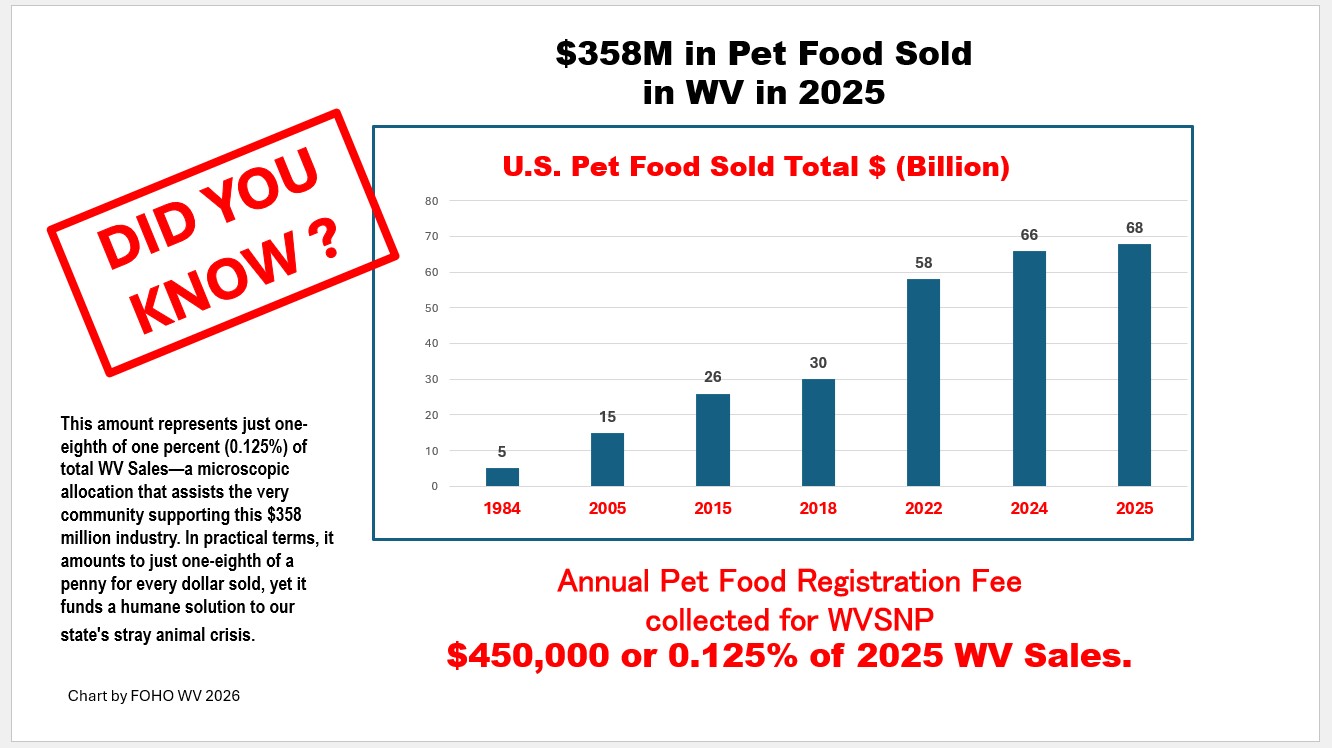
This is how it is funded now through a pet food registration fee with the WV Dept. of Ag. The graph shows that there has been no negative impact on the Pet Food Industry growth. It not on what is sold in the state, it is a fee on each brand registered regardless of how much is sold. It is a one time annual fee on brands. WVSNP taps $50 for large bag and $35 for small bag registration fees through the WVDA. In 2017, we had requested $100 for large bag and $70 for small bag which would have provided approx. $900,000 to the fund.
Traditionally, there are approximately 12,000 brands of Pet Food that are coming into WV. Since 2018 the number of brands of large bags registered was 10,016 and small bags was 2,389. In 2025, the large bag numbers of brands registered above that at 12,510 and the small bags was 2,481. Note only a small fluctuation in number of registered brands since the onset of the program funding.
The Issue
The West Virginia Spay Neuter Assistance Program (WVSNP) is facing a significant funding reduction beginning with the 2027 grant cycle. Since 2023, the program has been sustained by a one-time $1.8 million private grant awarded to the Federation of Humane Organizations of West Virginia (FOHO WV). That grant expires this year.
Without legislative action, the program will revert to its original state appropriation of just $450,000, an amount established in 2018 that no longer reflects current demand or costs.
The impact will be felt across all 55 counties, increasing financial pressure on county governments, municipal animal control agencies, shelters, rescue organizations, veterinary clinics, and ultimately West Virginia taxpayers.
How POWERFUL your argument to your legislators becomes when you make your case for our program showing them the actual dollars that have gone back into their counties.
From 2018 – 2025
$ 5,177,581 was added to local economies from payments to WV veterinary clinics for surgeries performed by veterinarians who are registered to practice in WV.
Total Spent includes over $1.9M matching funds paid by grant recipients. Check out this document which list every county and the dollars it received in total from WVSNP. We will update this at the conclusion of the 206.
There are some really powerful charts in this pdf which you can download and use as needed. It tells a graphic story of success. Share with your legislators letting them know how important it is that this funding continues forever.
The Facts
- Nearly 70% of West Virginia households own pets.
- WVSNP was originally proposed at $900,000 annually, but was reduced to $450,000 during the 2017 legislative process.
- In 2026:
- 100 organizations applied for funding.
- $1.9 million was requested.
- Only $1.2 million could be awarded.
- Funding reached organizations in 53 of 55 counties.
- The average cost of spay/neuter procedures has increased approximately 62% since 2018, reducing the purchasing power of the original appropriation.
Legislative Request
- Restore WVSNP funding to at least $900,000 beginning in Fiscal Year 2027, consistent with the original funding request when the program was created.
- Increase annual appropriations to no less than $1.5 million by 2032 to meet documented statewide demand and account for inflation.
Why This Matters
Spay and neuter programs reduce:
- Shelter intake
- Animal control costs
- Euthanasia
- Animal cruelty and neglect cases
- Public health concerns associated with stray animals
- Financial burdens on county governments and taxpayers
Every surgery performed today prevents future costs that otherwise fall on local governments, nonprofit organizations, and citizens.
WVSNP is a cost-saving investment—not simply an animal welfare program.
Impact on the Pet Food Market / They are doing just fine!
This is what we really need is to fully fund or WVSNP program Remember in 2017, we asked for $900,000 and we received only half of that funding.
WVSNP taps $50 for large bag and $35 for small bag registration fees through the WVDA. In 2017, we had requested $100 for large bag and $70 for small bag which would have provided approx. $900,000 to the fund.
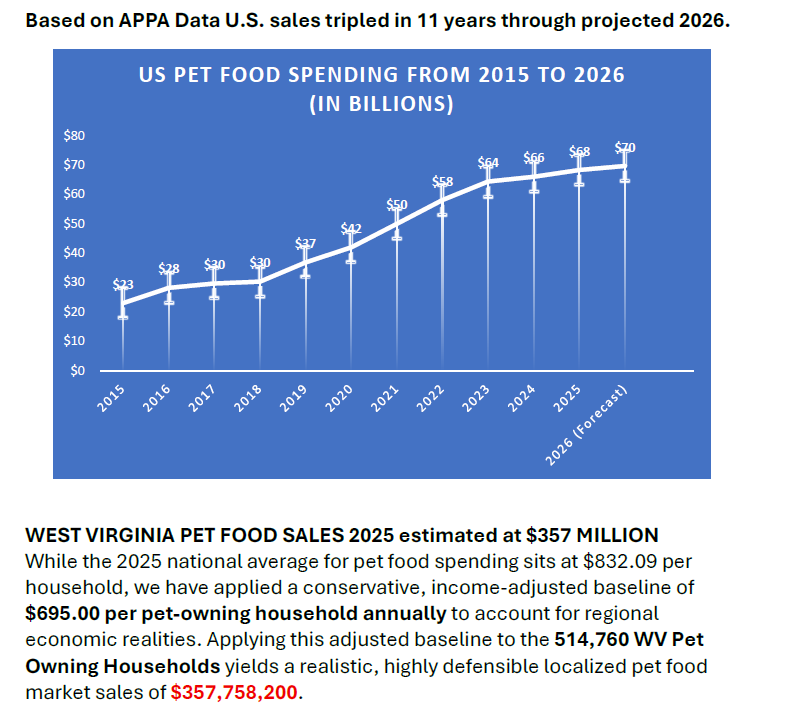
Traditionally, there are approximately 12,000 brands of Pet Food that are coming into WV. Since 2018 the number of brands of large bags registered was 10,016 and small bags was 2,389. In 2025, the large bag numbers of brands registered above that at 12,510 and the small bags was 2,481. Note only a small fluctuation in number of registered brands since the onset of the program funding.

Potential Funding Options
Several funding mechanisms could be considered, including:
- A modest appropriation from West Virginia Lottery proceeds deposited into the General Revenue Fund.
- A statewide license differential for unaltered dogs.
- A small rabies vaccination surcharge.
- A voluntary state income tax check-off.
- Pet-friendly specialty license plates as supplemental revenue.
A combination of modest revenue sources could provide long-term sustainability while minimizing fiscal impact.
The Bottom Line
West Virginia has spent nearly a decade building a successful statewide spay/neuter program. Allowing funding to fall back to 2018 levels would reverse years of progress and increase long-term costs for counties and taxpayers.
A modest investment today will prevent substantially greater public expenditure tomorrow.
Funding prevention is significantly less expensive than funding the consequences of pet overpopulation.
Restoring Funding for the West Virginia Spay Neuter Assistance Program (WVSNP)
A Preventable Funding Crisis
The West Virginia Spay Neuter Assistance Program (WVSNP) faces a critical funding crisis beginning with the 2027 grant cycle. Without legislative action, every one of West Virginia’s 55 counties will experience increased financial pressure through higher shelter costs, increased euthanasia, greater strain on animal welfare organizations and veterinary providers, and growing public health concerns. Because nearly 70% of West Virginia households own pets, the consequences will ultimately be borne by taxpayers statewide.
Since 2018, the program has been administered by the West Virginia Department of Agriculture. Although the original 2017 legislation sought an annual appropriation of $900,000, the final budget allocated only $450,000.
The program has remained successful only because of a $1.8 million grant awarded in 2023 by a private, out-of-state foundation to the Federation of Humane Organizations of West Virginia (FOHO WV). That grant expires this year. Beginning with the 2027 grant cycle, WVSNP will revert to its original state appropriation of just $450,000.
Demand Far Exceeds Available Funding
The current appropriation no longer reflects the need.
In 2026:
- 100 organizations applied for funding.
- Nearly $1.9 million was requested.
- Only $1.2 million could be awarded.
- Grants reached organizations in just 53 of West Virginia’s 55 counties.
At the same time, the cost of spay/neuter procedures has increased approximately 62% since 2018 because of inflation and rising veterinary costs. The purchasing power of the original appropriation has steadily declined while demand continues to grow.
Without additional funding, fewer surgeries will be performed, resulting in more unwanted litters, increased shelter intake, higher euthanasia rates, and greater costs for counties and municipalities.
Funding Recommendation
To maintain an effective statewide program, WVSNP funding should be:
- Restored to at least $900,000 annually beginning in Fiscal Year 2027, consistent with the amount originally requested by the Legislature in 2017.
- Increased through phased appropriations to no less than $1.5 million annually by 2032 to account for inflation, population needs, and continued program demand.
Potential Funding Sources
Several options have been identified that could provide sustainable support for WVSNP.
General Revenue from the West Virginia Lottery
In 2025, approximately $66 million in West Virginia Lottery proceeds were deposited into the State’s General Revenue Fund. A modest annual appropriation from these funds could restore WVSNP without creating a significant budget impact.
Historically, lottery proceeds have also supported other legislatively authorized programs, including the Greyhound Breeding Development Fund established in 1994.
License Differential for Unaltered Pets
A statewide license differential would add a surcharge to dog licenses for animals that are not spayed or neutered while maintaining lower fees for altered pets.
Only Connecticut and Delaware currently administer statewide programs of this type.
Comparable annual revenues include:
- Connecticut (population approximately 3 million): $484,000
- Delaware (population approximately 1 million): $68,000
A 2026 fiscal note for HB 4094 estimated that implementing such legislation in West Virginia would reduce county dog and kennel fund revenue by approximately $250,000 annually under current assumptions. However, only about 18% of dog owners currently purchase licenses, indicating that improved licensing compliance could significantly offset or eliminate this projected loss while strengthening responsible pet ownership.
Rabies Vaccination Surcharge
A $3 surcharge on rabies vaccinations has previously been proposed in West Virginia (HB 2966, 2011).
Delaware raises more than $336,000 annually through a similar veterinarian-collected surcharge. Previous opposition in West Virginia centered primarily on administrative paperwork rather than the surcharge itself.
Income Tax Check-Off
A voluntary income tax check-off was proposed in SB 479 (2012).
Based on previous estimates, this mechanism would generate approximately $22,000 annually. While insufficient as a primary funding source, it could supplement other dedicated revenues.
Pet-Friendly License Plates
A specialty “pet-friendly” license plate could dedicate a portion of registration fees to WVSNP.
Experience in other states suggests that this option would provide only modest revenue. Based on West Virginia’s population, estimated annual revenue would likely not exceed $30,000, making it better suited as a supplemental funding source.
Dedicated Lottery Scratch-Off Game
Research indicates that creating a lottery game dedicated to WVSNP is not currently feasible under existing West Virginia law because lottery proceeds are statutorily dedicated to senior services, education, and tourism. Kentucky’s animal-themed lottery game promotes animal welfare organizations but does not dedicate lottery proceeds directly to them.
Prevention Costs Less Than the Alternative
The West Virginia Spay Neuter Assistance Program is not simply an animal welfare initiative—it is a fiscally responsible investment in public health, public safety, and responsible government.
Every spay or neuter surgery performed today reduces future expenditures associated with animal control, shelter operations, euthanasia, law enforcement, disease prevention, and emergency animal care. Preventing unwanted litters is substantially less expensive than managing their consequences.
If West Virginia fails to invest a reasonable amount in prevention today, taxpayers will face far greater costs in the years ahead.
Restoring WVSNP funding is a practical, evidence-based investment that benefits counties, municipalities, veterinarians, shelters, taxpayers, and the millions of West Virginians who share their homes with companion animals.
FUNDING BACKGROUND / WV REVENUE:
The WV State Budget:
WV finished the fiscal year 2026 with a $370 million dollar surplus
With that surplus, the general revenue fund now totals $5.7 billion dollars which officials say is 7% above state estimates.
June collections were $569 million dollars which is an 11% increase. This surplus will cover our budget needs says Gov. Morrissey. He continues by saying this budget surplus will cover remaining budget needs such as roads, infrastructure and funding for the Hope Scholarship and more. Personal Income tax and severance tax all exceeded expectations.
*Information from Channel 5 news 6 pm on 7.1.26 offered by the Office of the Governor
The WV Lottery generated over $611.0 million in proceeds for the People of West Virginia in seniors, education, and tourism in Fiscal Year 2025.
$1.3 Billion Generated in total revenue for fiscal year 2025
$611 million total WV
$93.7 million Senior Service
$142.5 million Education
$63 .5 million Tourism
$522,000 Veteran Services|
$46.4 million Infrastructure Council
$198.8 million Other state agencies
$66.2 million State General Fund
$27.7 million Paid to county and local municipalities across the state from gaming revenue
$150.7 million Total awarded to players in traditional lottery prizes 4% Operating costs of total sales.
Note: 2026 Total lottery sales reached nearly $1.2 billion by the 10-month mark. f Fiscal Year 2026, tracking ahead of its initial revenue expectations with two months left to go in the budget year *WV Metro News 5/27/2026
*West Virginia Lottery FY 2025 Progress Report
Here is a handy bulleted list overview of WVSNP for download. Further below are two charts that graphically show progress.